Saturday, April 18, 2026

What Happens When You Finally Sit Still

Quietly, Evelyn Life in Sync

What I Noticed When I Finally Sat Still

"You stop moving and the world keeps going and slowly you start seeing it again."

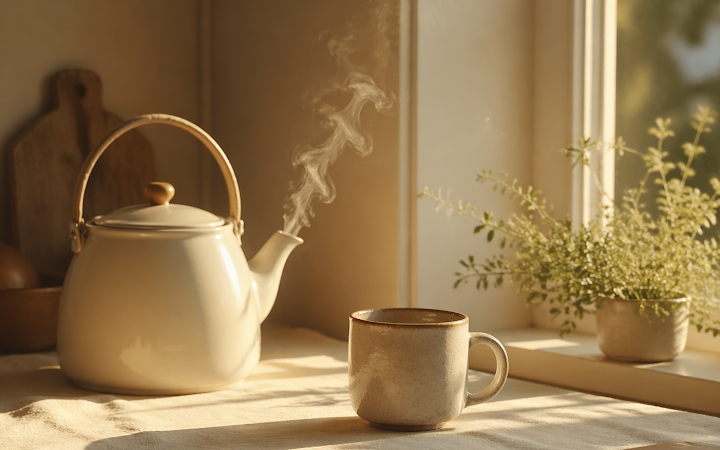
There was a cup of tea going cold on the windowsill, and I wasn't going to do anything about it.

I don't know when sitting still started to feel like something I had to earn. Somewhere between the to-do lists and the open tabs and the low-level hum of keeping things together, I stopped just being in a room. Even when I was resting, I was resting at something. Scrolling. Listening to a podcast. Answering the one quick thing before I put the phone down.

This past week, I sat in the kitchen with nothing in my hands. Not on purpose. I'd meant to do something else, and then I didn't, and ten minutes passed.

April light does something strange to this room in the late afternoon. It comes in sideways and catches the edge of things: the rim of a glass, the corner of a book spine. Everything gets a shadow it didn't have an hour ago. I don't know when that started. I'd been in this kitchen every day and I hadn't noticed.

That's the thing about stillness. It isn't restful, not exactly, not the way sleep is restful. It's more like: you stop moving and the world keeps going and slowly you start seeing it again. The basil on the sill, leaning toward the glass. The particular sound the refrigerator makes. Small, ordinary things that have been happening without you.

I'm not here to say sit more. I barely manage it myself. But I think there's something worth paying attention to in those accidental pauses. The ones you didn't plan for, and didn't fill.

The tea was cold. I drank it anyway.

What's the last small thing you actually noticed, when you weren't trying to?


Warmly, Evelyn

Wednesday, April 15, 2026

The Smallest Book That Stayed the Longest

Quietly, Evelyn Pages & Perspectives

The Smallest Book That Stayed the Longest

"Some books stay not because they said something large, but because they were so quiet you had to lean in."

Several copies of The Summer Book beside a mug and cream kettle in warm kitchen light

There is a scene early in The Summer Book where a six-year-old girl and her grandmother are lying flat on the rocks, watching ants carry things across the stone. They do not say anything particularly important. The moment does not lead anywhere. And yet I kept thinking about it for days afterwards, the way you keep thinking about a good meal you forgot to photograph.

Tove Jansson — who most people know for the Moomins, if they know her at all — wrote this novel in the early 1970s. It is about a grandmother and her granddaughter spending summer on a tiny Finnish island. It is very short. People tend to say that first, almost apologetically, as though a book should justify taking up less shelf space.

But the shortness is the point. Each chapter is its own small event: a walk, a storm, a discovery of moss, an argument about absolutely nothing. The grandmother is old and stiff and magnificent. The girl is wild and curious and sometimes rude. Together they are the best company I have had in a book for a long time.

What I love most is the attention. Jansson writes about an island the way someone writes about a person they have loved for decades — not with romance, exactly, but with the kind of familiarity that notices everything and says just enough about it. The rock pools. The weather turning. The way light changes across a Nordic evening.

There is one chapter where the grandmother tries to build a Venice out of whatever she can find on the island. Driftwood, shells, bits of nothing. It is absurd and wonderful. I think about that scene when I am trying too hard to make something work — the way she just got on with it, badly, with great concentration and no grand plan.

Jansson herself lived on a small island in the Gulf of Finland for decades. You can feel it. She wrote about nature not as scenery but as weather and rock and inconvenient seawater. There is no sentimentality in it. Just a clear-eyed love for a place that was sometimes very difficult and always entirely itself.

I had been in a reading rut when I picked this up. Months of starting things and setting them down again around page forty. The Summer Book did not fix that, exactly. But it reminded me that a book does not need to be about something large to feel important. Sometimes the smallest story is the one that takes up the most room in your head.

It is a book I keep giving to people, not because I think they need it, but because I want to talk about it with someone who gets it.

If you'd like to pick up a copy, I've linked it below. (Affiliate links — I may earn a small commission at no extra cost to you.)

Disclosure: this post contains affiliate links. If you purchase through them, I earn a small commission at no extra cost to you. I only ever recommend books I genuinely think are worth your time.

Have you read a book so short it felt like a secret — one you kept pressing into other people's hands just to see if they felt it too?


Warmly, Evelyn

The Quiet List, April 2026

Quietly, Evelyn Life in Sync

The Quiet List, April 2026

"The useful things this month have all been small. I am choosing to see that as a good sign."

An open notebook with tea, a pen, and spring details on cream linen in warm light

April did that thing again where the first two weeks felt spacious and possible and the second two felt like someone had quietly added thirty per cent more week to every week. Not in a catastrophic way. Just in the way where you find yourself standing in the kitchen at four o'clock trying to remember whether you ate lunch or just thought about it very convincingly.

So this is the first Quiet List — a small monthly note of what has actually been working. A book, a habit, a few small things. Nothing revolutionary, which is rather the point.

This post contains affiliate links. If you buy through them, I may earn a small commission at no extra cost to you.

1. Drinking my coffee standing at the window

I don't know exactly when this started. But it has become the most defended five minutes of my morning. Not sitting down, not checking anything, just standing there like a mildly caffeinated sentry watching the street wake up. If I sit, the phone appears. If I stand, I just look. Something about the posture keeps me honest.

2. How to Do Nothing by Jenny Odell

I expected something contrarian and smug and instead got a book that made me think differently about attention. Odell writes about birdwatching, public parks, and what it actually means to be present somewhere instead of performing presence. I keep underlining things and then forgetting which page I underlined them on.

3. Walking with nowhere in particular to be

Not exercise. Not a podcast walk. Just feet moving while my brain catches up with itself. I have been doing this twice a week, badly and with no consistency, and it is still the thing I am most grateful for this month.

4. The good soap I keep saving for guests

We do this, don't we? Hoard the nice things in case a more deserving moment turns up. I used the good soap this month. Nobody came over. It smelled like eucalyptus and felt like a very small rebellion.

5. Writing three sentences before bed

Not a journal. Not morning pages. Just three sentences about the day in a notebook that cost less than a coffee. Most of them are boring. That is not the problem I thought it would be.

What is the small, almost invisible thing you have been reaching for this month — the kind that sounds like nothing until you realise how much of the day it is holding together?


Warmly, Evelyn